
Where do you stand on the cork versus screw cap debate? Perhaps, like several of the recent dinner guests around my kitchen table, you really don’t care, so long as the wines taste good and keep on flowing. Or maybe you are more in tune with the “natural is best” camp, believing the odd ‘corked’ bottle is a price worth paying for the support of Iberia’s cork oak plantations which offer both a haven for biodiversity and a traditional way of life. If so, Prince Charles is on your side. There is also no doubt that the ritual of pulling a cork – complete with that satisfying ‘thlwopp’ – is a romantic and surefire way to whet the appetite.
HRH, though, is less likely to be troubled by the hugely frustrating problem of carrying a bottle home to find it smells and tastes like it’s been dosed with an infusion of moldy cardboard, dead mouse and barnyard droppings. ‘Cork taint’ is caused by an unwelcome brute of a molecule with a long chemical name, commonly shortened to TCA. Harmless, but detectable to humans in doses as low as a few parts per million, it can affect barrels, storage racks, even be carried on glass, but it’s most infamous carrier is the cork used to seal the bottle. Trade estimates range from 3-5% of wines affected, or ‘corked’ to use the popular term.
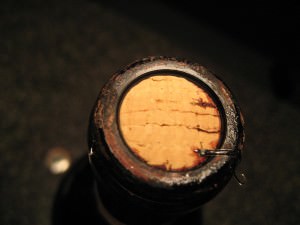
An old cork in an old bottle of wine – Photograph by Sylvie Szafranski
The worst thing about this, however, isn’t the clearly undrinkable stinker of a bottle. Rather, it’s the wine with a very low dose of TCA, which simply knocks out the joyful fruity character, leaving a dull, hard-edged and uninspiring mouthful on offer instead. In these (many) cases, it’s not usually the cork that comes under suspicion. Instead it’s the winemaker’s reputation that is on the line and, without knowing the real culprit, unhappy customers won’t be buying the producer’s vino again.
No wonder, then, that innovative New World producers, wearing their ‘can do’ hats, have embraced screw caps with gusto. Argentina’s producers, although more conservative than some of this front, are increasingly keen to trial modern technology over a blob of bark. So, while higher-end Argentine wines are still typically bottled under cork – as elsewhere in the world – more affordable bottles increasingly use screw caps to seal the wine.
“Argentina has a lot of boutique, high-end producers, making a lot of red wine, and also many of these producers lean towards the Old World so they have favored traditional closures,” says Neil Keiling at South American specialist Hispamerchants. “However, with wines meant to be drunk young, like Torrontés, the appeal of screw cap is increasingly obvious and some reds are now also under screw cap.”
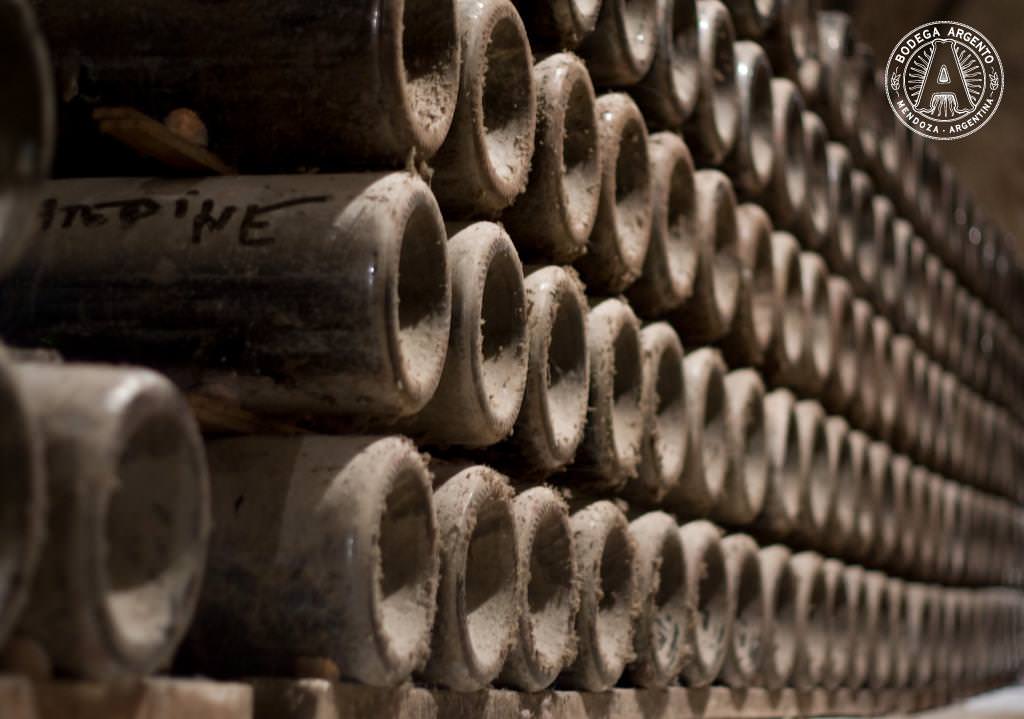
These bottles are unlikely to have screw caps… – Photograph by Simon Greig
There’s little reticence with the most forward-looking producers — it’s notable that the wines of Argento use screw cap, as fruit purity and freshness are central to their winemaking philosophy. Silvia Corti, Argento’s winemaker explains, “We use screw caps because we want to ensure that our wines arrive in the market exactly as I intended them.” This trend is clearly catching on, as leading screw cap producer Guala Closures reports, with over 150 million screw caps used in Argentina last year and the number growing fast.
After all, what’s the point of buying a cracking Malbec if you then discover its berryish, plummy concentration is masked by malodorous TCA? Or a Torrontés, which should be dancing with aromatic intensity, if it smells like a musty old sock? With a screw cap this is incredibly unlikely to happen. And then there is the ease…
I must admit, in my time I’ve used cutlery, metal kebab sticks and even my thumb (painful!) to push a cork into a bottle and release the liquid inside, usually at an impromptu picnic or BBQ where no one just happened to be carrying a corkscrew. This is also how I inadvertently tie-dyed a shirt Malbec-purple on the overnight bus from Mendoza to Patagonia after I’d been given a fine bottle and glass – but no corkscrew – to help pass the ride.
With a screw cap, however, there’s no such trauma – it is both the corkscrew and a handy re-sealer all rolled into one. Better still, it best ensures the wine tastes as the winemaker intended. Which is why I want my Malbecs and Torrontés, Syrahs and Chardonnays, Cabernets and Viogniers, and other great Argentine flavors beside, to come with a twist.
Well, that and an asado…

Latest posts by Andrew Catchpole (see all)
- Taste the Diversity: A Guide to Argentina’s Wine Regions - October 22, 2014
- The Global March of Malbec - October 1, 2014
- ‘Take 5’ Global Sommeliers: Argentine Food & Wine Pairings - April 16, 2014
 A Taste of Terroir: Argentina’s Diverse Wines & Wine Regions
  ‘Take 5’ Global Sommeliers: Argentine Food & Wine Pairings
  The New Wave of Wine from Argentina
  Top 10 Curious Facts About Argentina Wine
  ‘Take 5’ Food & Wine Pairings from Top Argentine Sommeliers
  Know La Rioja, the famous wine region of Argentina
  Wine Tasting in Argentina: Interview with Three Top Sommeliers
  Argentina Wine Regions: Salta
  Taste the Diversity: A Guide to Argentina’s Wine Regions
  On the trail of Patagonia’s Pinot Noir
  Argentina Wine Regions: San Juan
  450 Years of Wine in Argentina – A Potted History
Having thrown away over the years more than a dozen expensive corked wines, I am opposed to using cork (period). Rarely will I buy a white wine that is not in a screw cap bottle, the exceptions being a couple of fairly expensive whites, such a Rutini, because they are just so good that I'll put up with the cork BS for them. But for daily wines, I will not buy a bottle that does not come with a screw cap. I drink more whites than reds (reds saved for meat dishes, whites for everything else), so the cork is less a bother. But if there were good reds available with screw caps, I would always buy them over anything with a cork. This is the opinion of someone who drinks wine everyday.
That's great, Donigan, thanks very much for your perspective in the debate.
I'm leaning screw cap. The only thing I really miss about corks is the satisfying noise they make when pulled from the bottle. If someone could only develop a screw cap which emitted the same sound when twisted anti clockwise, I'd be a fully paid-up convert.
I strongly prefer corked wines. I don't know why, but when I see a screw cap I get the impression that it is a cheap wine. Logically I know that this is not always true, but I still buy the corked wines. I guess that eventually I will have to keep up with the times and start making the switch!
The question no-one considers (but us) is whether there is any way to remove a screwcap from a bottle with the grace and flair of cork pulling.So we considered it: http://www.sedimentblog.blogsp…
To settle a bet with friends — aside from people's pre-conceptions about screw tops, are there any drawbacks to using them? My Old World (French) friends argued that screw tops are not used for expensive wines because there after a long period of time they begin to 'rust' or somehow taint the wine's flavour. I had heard otherwise, that in fact screw tops were an almost flawless long-term solution.
Thanks for the comments Dan. I'd say your bet is in the bag, the wine doesn't come into contact with the metal as there is a plastic seal under the cap. It is worth bearing in mind, though, that screw cap sealed bottles are best stored upright which ensures that there is no possibility of the wine in any way being compromised. And yes, long term trials by companies including Penfolds (not Argentinean, I know) with high end red wines have shown that the screw cap is indeed as close to flawless as possible with current closures widely available.
All best
Andrew
Thanks for all comments above. I agree, cork is more romantic, but no where near as romantic as being able to drink and enjoy a bottle as the producer intended it! And the image of screw cap being cheap (it's more expensive than the cheaper composite corks, by the way), is one of perception, and this is changing fast. It is worth remembering, too, that in top restaurants it's possible to spend a fortune on a bottle of 'designer' water which will be sealed with screw cap and I've never head anyone suggest that this has cheapened their perception of a Michelin star dining experience. After millions of years of that water filtering through ancient volcanic rock (or whatever) few water producers would take the risk that their water will be tainted by a closure… So why do we put up with a faulty closure for wine?
Like you Malbeceamos, I love the image and feel of the cork, but I love my wine more!
Happy imbibing
Andrew
Dear Andrew,
I live in France but on an extended visit to Houston, I was introduced to Malbec and haven't stopped drinking it. However, last night at an excellent restaurant we ordered the cheapest Malbec, about $19 (very sorry but I forget what it was). It came with a screw top. I tasted it, and shocker! It tasted corked to me. The waiter was displeased. (Few Americans even know what corked means, and as I tried to explain to my friends at the table, they rightfully pointed out the puzzling fact that there was no cork in the wine bottle, only the screw cap.) We tried another bottle of the same, and though the immediate aroma and taste was better, eventually the moldy, flat smell and taste started creeping into my glass of the second bottle. So in the end I had to agree with the waiter, who claimed it was just the wine itself, not a bad bottle, although why the restaurant would continue to sell undrinkable wine was beyond me.
Could you help me understand this? How was it that a wine with a screw top would be corked? You mentioned the slight possibility of that.
Thank you.
Susan
what’s the best wine to have with cod n’ chips and mushy peas? oh and a pickled gherkin
[…] teenagers in parks celebration Lambrini by straws. I’ve review a few articles online here and here, that seem to uncover some advantages to screw tip bottles (namely that they aren’t […]
[…] of teens in parks drinking Lambrini through straws. I’ve read a few articles online here and here, which seem to show some benefits to screw top bottles (namely that they aren’t affected by […]
[…] of teens in parks drinking Lambrini through straws. I’ve read a few articles online here and here, which seem to show some benefits to screw top bottles (namely that they aren’t affected by […]
[…] of teens in parks drinking Lambrini through straws. I’ve read a few articles online here and here, which seem to show some benefits to screw top bottles (namely that they aren’t affected by […]