
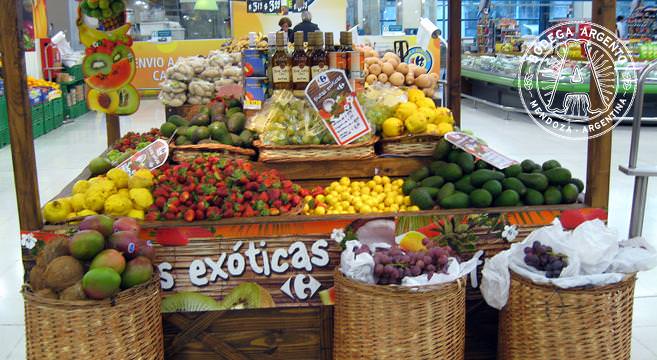
At first glance, an Argentina supermarket is like any other. Then you notice the whole aisle devoted to yerba mate, a vegetarian section that consists only of cardboard-like soya milanesas, and – as one blogger has noted – an astounding number of variations on tinned corn.
Exotic fruit at a Carrefour in Buenos Aires – Photograph by christine592
If you are looking to get under a country’s skin, you need to get to know its supermarkets. In Argentina, the big ones are Coto, Disco, Jumbo and French mega-chain Carrefour. These are the big strip-light, no-window places, where you’ll find cosmetics and home goods alongside your groceries. The fruit and vegetable sections tend to be fresher than small neighborhood supermarkets, but may not match your local verdulería (selling fruit and veg only).
If you’re craving variety, the huge Jumbo in Buenos Aires’s Palermo (Bullrich 345) is the place to go. It’s been nicknamed the ‘international supermarket’ for its range of imported products, although you will pay a premium for these (it’s also worth noting that locals, quite frustratingly, bend their own rules here and do pronounce the ‘j’ in Jumbo. Don’t make the ‘Humbo’ mistake).
There is no such thing as quickly ‘popping out’ to a big Argentina supermarket. As one friend points out, “Babies have been conceived and born quicker than a trip to buy a bag of milk in a Coto on a Thursday evening.” Why? Not only does a national shortage of small change cause checkout tailbacks, but also most customers are shopping as if they could be under house arrest from tomorrow. They pile those trolleys up to the brim, safe in the knowledge that they can request home delivery at the till. If you want to give it a try, go to the special ‘envío a domicilio’ checkouts, where your goods will be packed into crates and delivered your door. Sometimes this free, sometimes there is a fee; check in advance and be sure to tip on arrival.
Some other linguistic points to note: when an Argentinian says they want to get to the ‘disco’ before it closes, unless it is close to dawn they are probably not going to a nightclub; instead they’ll be heading to the supermarket chain of the same name. Similarly, when someone says they are going to get something to eat from the ‘chino’, don’t expect them to come back with chow mein. They are referring to the small neighbourhood supermarkets that are typically run by Chinese immigrants.

Cooking on the street in Barrio Chino – Photograph by Alfredo Miranda Kleber
Buenos Aires’s Chinatown (Barrio Chino in Belgrano) is another good place to add some variety to the usual meat-orientated, spice-free diet. Supermarkets, like Casa China, are a joy to explore and you’ll find not just Asian products, but a range of ‘ethnic’ foods that even spans as far as Branston’s Baked Beans (priced at a shocking 20 pesos per can. And they’re not even Heinz).
Finally, whatever part of Argentina you are visiting, don’t miss the small neighbourhood shops for a real taste of Argentina food. Your local carnicero (butcher) will often be happy to talk you through the different cuts, and at the panadería (bakery), you can get a sugar rush from cakes loaded with dulce de leche. For months, I was buying dried pasta in a plastic bag, until I discovered an old-fashioned (and incredibly well-priced) pasta specialists, making fresh spaghetti through hand-wound machines.
Shopping from store to store may take time, but you’ll often get plenty of banter to help you along the way. And rest assured that it’s probably still quicker than getting stuck in the home-delivery line at Jumbo.

Latest posts by Vicky Baker (see all)
- The Real Tango Experience in Argentina - May 1, 2013
- In Case You Haven’t Heard, the Pope is from Argentina - March 20, 2013
- Argentinian Culture Around the World - January 8, 2013
 Shopping for Leather in Buenos Aires: An Insider’s Guide
  Argentinian Delicacies on Your Doorstep
[…] on for a recent article about food shopping in Buenos Aires, I want to give a shout out to my local pasta maker, Impacto Fabrica de Pastas (Carranza […]
[…] on for a recent article about food shopping in Buenos Aires, I want to give a shout out to my local pasta maker, Impacto Fabrica de Pastas (Carranza […]
Hi,
I found your company from the Internet.
We are a company based in the UK and are involved in bringing new and unique products to the market.
We have launched a new product which is called AnySharp – a unique knife sharpner.
It will sharpen any object with a blade and is very unique to the industry and there is definitely nothing like this out there in the market.
We also have launched a very clever pair of scissors which will vut just about anything with added extras.
We are looking for a distributor in your country with an option to becoming exclusive. I am hoping that this is something you would be interested in
If it is not would you be able to point me in the right direction of a company that would
Please take a look at our website for all the details:
http://www.anysharp.com
http://www.sizzors.co.uk
We are able to send you samples so you can physically take a look at the product, and I can assure you there are good profit margins in this product.
We currently have distributors in the following countries:
USA, Spain, South Africa, South Korea, Germany, France, Canada, UK, Belgium, & Scandanavia and are looking to extend our relationships.
The Anysharp product is the best selling product on http://www.amazon.co.uk and are very confident it can be just as successful in your country
I look forward to your thoughts.
Thank You,
Yusuf Vindhani
Krystal Inkz
E: [email protected]
Good Afternoon
I am a British Food Exports currently exporting all over the world a wide selection of British brands from Confectinery, ambient grcery and chilled products. I am tring to locate your buying team to discuss our ranges. I am wondering if you have any contacts or know a organisation that might be able to help me make contact with some Argentinean supermarket import buyers. Thanks for your help
Hi Mark — The Real Argentina is brought to you by the Argento Wine Company, an Argentine wine producer. I'm afraid we don't have any contact with Argentinian supermarket import buyers, so can't be of any help. Good luck.
Hi
Do you know where I can buy British products in Buenos Aires? Looking for some Marmite or Robinsons!! 😉
Hi Mark. Not my area, I'm afraid. But put the words 'Argentina' and 'import' together, and all I do know is they won't make it easy for you. Suerte!
hi, dear friends, anyone know argentina poultry products company ?we are looking for poultry products company in argentina ,for purchase some containers chicken wings, chicken paws to china market ..please contact me by :[email protected]